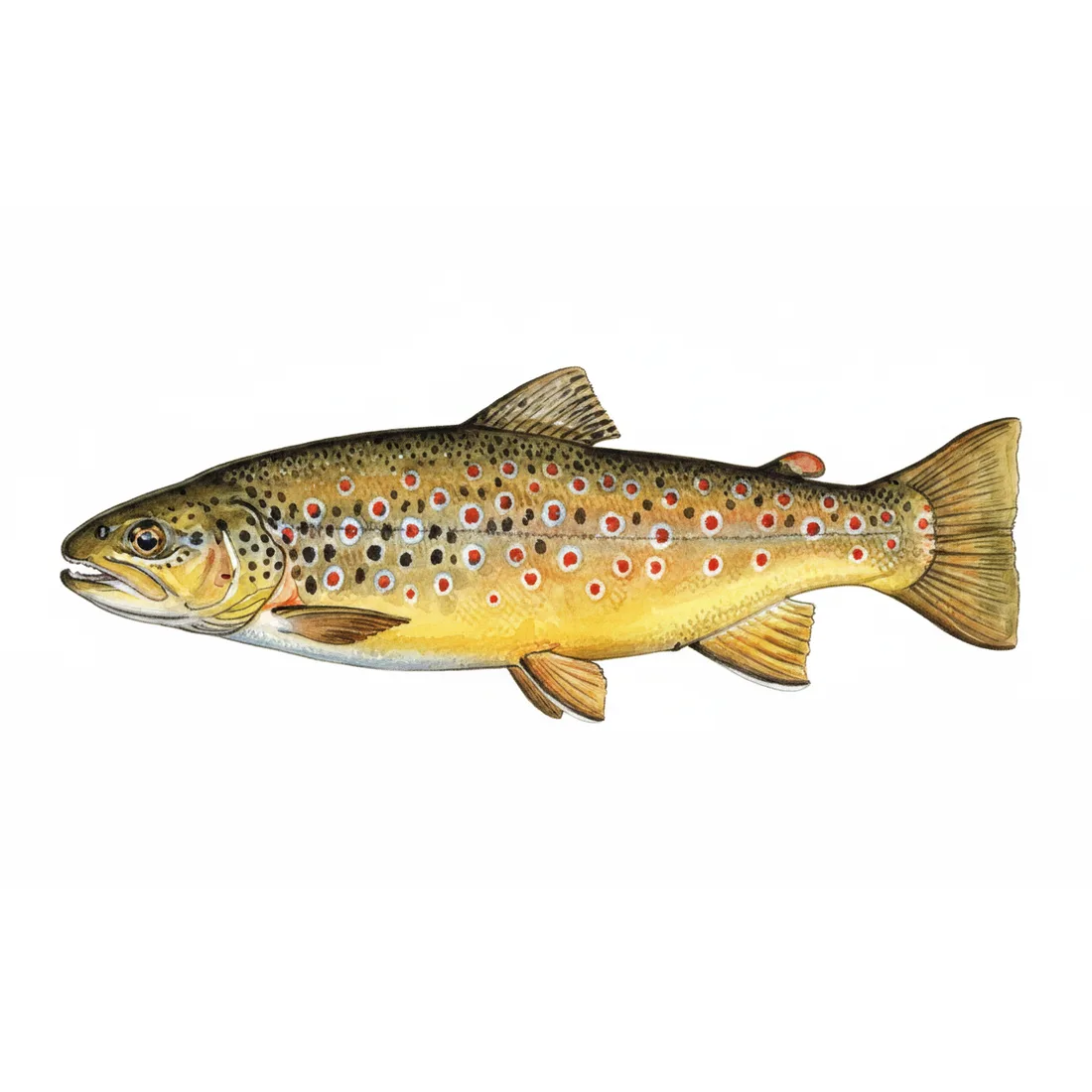
 Illustration· After a photo by Gilles San Martin (CC BY SA 2.0)
Brown trout
Breac · Salmo trutta · Salmonidae
Overview
Ireland's premier native game fish is also its most misleadingly "multiple" one. Brown trout, lake ("lough") trout and sea trout are not different species — they are one species, Salmo trutta, expressing different life-history strategies. A single spawning population in a west-of-Ireland river can produce siblings that never leave the stream, siblings that drop into a lough and grow into a heavy lake trout, and siblings that run to sea and return silver and sea-liced as a "white trout". Which path a fish takes is a mix of genetics and opportunity, not a taxonomic fork — which is why the same river can hold spring-lean brownies, autumn-fat lough fish and summer-run sea trout all as part of one breeding population, and why the sea-trout collapse of the early 1990s hit a form of brown trout, not a separate fish.
Life history
The core biology — partial migration
Brown trout is a textbook case of partial migration: within a single population some individuals stay resident and some migrate, and the split isn't fixed. The species expresses up to five life-history forms over two basic patterns — resident (river- or lake-resident) and migratory (fluvial-adfluvial: river-to-river; lacustrine-adfluvial: river-to-lough-and-back; and anadromous: river-to-sea-and-back, the sea trout). Roughly half the variation in migratory tendency is genetic, the rest driven by condition and local opportunity. Migration is a trade-off between growth opportunity and mortality risk: anadromy carries the largest growth benefit but the largest risk.
Spawning (autumn–winter, typically October–December)
The female cuts a redd in well-oxygenated river gravel with her tail; eggs are laid and fertilised by an attendant male, then covered. Every life-history form — sea trout, lake trout and river trout alike — spawns in flowing fresh water; none spawn in still water.
Egg to alevin (winter–early spring)
Eggs incubate in the gravel at a rate set by water temperature. On hatching the fish is an alevin, still carrying a yolk sac, and stays hidden in the gravel until it's used up.
Fry (spring)
The alevin emerges as "swim-up fry" and begins feeding for itself on tiny invertebrates.
Parr / juvenile
Young trout hold territory in nursery streams for one to several years, feeding on freshwater invertebrates. This stage is common to every life-history strategy — a future river-resident, lough trout and sea trout are indistinguishable as parr, and where resident and migratory adults share a catchment they interbreed freely.
The fork — resident, lough, or smolt
After one to a few years, each juvenile either stays put, drops into a lough to grow on as a lake trout, or smolts — undergoing the same silvering and osmoregulatory change as Atlantic salmon parr — and migrates seaward, usually March–June.
Marine/estuarine phase (sea trout only)
Unlike Atlantic salmon, sea trout don't undertake a long oceanic migration — they stay in nearshore, estuarine and inshore coastal waters, feeding intensively (often on sandeels, sprat and other small fish plus crustaceans) for rapid growth, then return to fresh water within the same year or after one or more winters at sea. This close-inshore habit is exactly why sea trout are so much more exposed to sea lice from coastal salmon farms than migrating Atlantic salmon smolts, which pass through more quickly.
Return and repeat spawning
Fish returning after less than a year at sea are finnock; those delaying a year or more are sometimes called "maidens". After spawning, a spent fish is a kelt. Unlike Pacific salmon (semelparous — one spawning event, then death), Salmo trutta is iteroparous: trout, including sea trout, can survive spawning and return in subsequent years, though repeat-spawning rates and kelt survival vary by population and condition.
At a glance
- Scientific name
- Salmo trutta Linnaeus, 1758 (sea trout = anadromous form of the same species, sometimes written S. trutta trutta)
- Typical adult size (river/small-stream fish)
- ~1 kg or under, highly variable by system
- Typical adult size (lough fish)
- 40–80 cm, up to ~140 cm in exceptional cases
- Maximum recorded size
- Up to ~20 kg / 100+ cm reported for large lacustrine trout in parts of the native range (ferox ecotype reaches the largest sizes)
- Irish rod-caught lough record
- 26 lb 2 oz, Lough Ennell, 1894 (Wm. Mears)
- Irish rod-caught river record
- 20 lb, River Shannon at Corbally, 1957 (Major Hugh Place)
- Lifespan
- Commonly cited up to ~20 years; much shorter typical, especially for males, many of which die after spawning
- Spawning window
- Autumn–winter, typically October–December
- Smolt (seaward) migration window
- Typically March–June
- Habitat
- Cool, well-oxygenated rivers, streams and loughs; sea trout also use estuarine/nearshore coastal water
- Diet
- Invertebrates throughout life; larger fish (roughly >30 cm) shift substantially toward piscivory
- IUCN status (species, global)
- Least Concern (2013 assessment) — masks serious regional/local declines
Naming & etymology
- Salmo trutta
- Linnaeus, 1758. Salmo is the classical Latin word for salmon/salmonid; trutta is Latin for trout. Linnaeus originally described river and lake forms as separate species (S. fario, S. lacustris); these were later shown to be morphs of one polymorphic species, not distinct taxa.
- Breac
- General Irish word for trout, and more broadly "speckled thing" (it also gives bricíní, freckles) — from Proto-Celtic *brikkos, "speckled, spotted". Brown trout specifically is breac buí or breac rua; sea trout is breac mara ("sea trout/fish"). Cognates run across the Celtic languages (Scottish Gaelic breac, Manx brack/breck, Welsh brych-).
- White trout
- Standard Irish vernacular for adult sea trout. First-return, under-a-year-at-sea fish are called finnock in Ireland (whitling or herling in parts of Scotland/England); a "maiden" sea trout is one that has delayed its first return by more than one summer.
- Regional sea-trout names
- Vary sharply by region: Welsh sewin, Scottish finnock/herling, south-west English peal/peel, north-west English mort. Irish river nicknames for finnock-stage fish also exist — "blueheads" in the south-east, "juners" on the Waterville (Currane) system in Kerry — though these are angling-forum usage, not an IFI-published glossary.
In Ireland
Brown trout is Ireland's most widespread fish, present in practically every stream, river and lake, and is used as a bioindicator because it needs relatively clean, well-oxygenated water. The great limestone loughs — Corrib, Mask, Sheelin, Conn, Arrow and Derg — are internationally known wild brown-trout fisheries, celebrated for mayfly hatches and the "duffer's fortnight" window in May. IFI's National Brown Trout Programme has run genetic and population studies across Corrib, Mask, Ree, Sheelin and associated river systems since 2006.
Lough Melvin's three sympatric forms — ferox, gillaroo and sonaghan — are the most extreme documented case of within-lough divergence in Irish brown trout, reproductively isolated from one another within the same water body (see the separate gillaroo, sonaghan and ferox records). Ferox — the large, piscivorous, long-lived lake ecotype — also occurs, non-reproductively-isolated, in other big Irish loughs, notably Corrib and Mask, which between them hold the large majority of Ireland's recorded specimen ferox trout.
The sea-trout collapse of 1989/90 is the single most important recent conservation event in Irish trout natural history. Sea trout stocks on the Galway/Mayo (Connemara) coast declined sharply from 1987 and collapsed in 1989–90: finnock were virtually absent in the 1989 rod catch, and rod catches on Connemara fisheries, historically averaging around 10,000 fish a year, fell to roughly 200 in 1990 and have not recovered since. Heavily sea-lice-infested wild sea trout were first recorded in aquaculture areas at exactly this time; the government's 1991 Sea Trout Working Group and the Marine Institute's National Sea Lice Monitoring Programme were established directly in response. Because sea trout spend extended periods feeding in nearshore coastal waters close to where farms are typically sited, they're exposed to lice for longer and at closer range than migrating salmon smolts. Primary Irish evidence (Gargan, Tully & Poole 2003 across west-coast systems 1992–2001; Gargan, Kelly, Shephard & Whelan 2016 on the Erriff River) links sea-lice infestation to depressed sea-trout marine survival — though a 2025 rebuttal paper disputes 13 of 15 response variables in the single-river Erriff study specifically, so the multi-river, multi-decade evidence base, not the Erriff story alone, should carry the causal claim.
Sea trout in Ireland are concentrated on lower-productivity, typically west-coast river systems; brown trout (river- and lough-resident) occur essentially everywhere suitable habitat exists, with the limestone midlands/west loughs as the standout fisheries. The species overall is IUCN Least Concern, but this global rating sits above real, locally severe declines — the sea-trout collapse being the clearest Irish example.
On the water
Context, not tactics.
- Because juvenile trout of every eventual life-history type share the same nursery streams and are visually indistinguishable as parr, a healthy river's future lough and sea-trout runs depend on the same small-stream habitat that produces its resident river trout.
- The autumn spawning migration and the spring smolt run are fixed, biologically-driven windows that shape when migratory fish are present in a river versus a lough or the sea.
- The shift toward piscivory in larger trout (roughly >30 cm) is the biological reason big lough trout behave, and are targeted, differently from the invertebrate-feeding average.
- Sea trout's close-inshore, nearshore habit is part of why they return to fresh water fit and testable across a season, and is also the same trait that leaves them exposed to coastal sea-lice pressure.
Key forage
Waters that hold this fish
Sources & how we know this (27)
- Brown trout is Ireland's most widespread fish; found in practically every stream/river/lake
Inland Fisheries Ireland, species page · 2026-07-09 - Spawning Oct–Dec on well-oxygenated gravel; redd/alevin/fry stages
Inland Fisheries Ireland, species page · 2026-07-09 - Habitat/thermal/oxygen preference; pollution tolerance limits
Inland Fisheries Ireland, species page · 2026-07-09 - Sea trout = same species as brown trout; smolt migration March–June; finnock vs "maiden" terminology; nearshore marine phase
Inland Fisheries Ireland, sea trout species page · 2026-07-09 - Sea trout classified as threatened; west-coast, low-productivity river distribution; catch-and-release recommendation
Inland Fisheries Ireland, sea trout species page · 2026-07-09 - National Brown Trout Programme scope; Great Western Lakes genetics work since 2006
Inland Fisheries Ireland, National Brown Trout Programme · 2026-07-09 - Brown trout life-history polymorphism: resident vs fluvial-adfluvial vs lacustrine-adfluvial vs anadromous forms; ~50% genetic variance in migratory tendency
Ferguson, A. et al. (2019), Journal of Fish Biology · 2026-07-09 - Polygenic basis of migratory divergence (~329 differentiated genomic regions)
Whole-genome resequencing study on migratory life-history divergence, PMC · 2026-07-09 - Resident trout can parent anadromous offspring; kin-clustering in migration timing (non-Irish population)
Long-term brown trout monitoring study, PMC · 2026-07-09 - Iteroparity in Atlantic salmonids incl. brown/sea trout; contrast with semelparous Pacific salmon
Review of iteroparity in anadromous salmonids, Reviews in Fish Biology and Fisheries (2023) · 2026-07-09 - Etymology of Salmo trutta; Linnaeus 1758; S. fario/S. lacustris later folded into one species; general size/lifespan/diet
Wikipedia, "Brown trout" · 2026-07-09 - Etymology of Irish breac ("speckled", Proto-Celtic *brikkos); cognates in Scottish Gaelic, Manx, Welsh
Celtiadur (Omniglot), "Trout" · 2026-07-09 - Regional sea-trout vernacular names (sewin, finnock, herling, peal, mort, white trout)
Wikipedia, "Sea trout" (cross-checked against Wild Trout Trust glossary) · 2026-07-09 - Irish regional finnock nicknames ("blueheads" SE Ireland, "juners" Waterville/Currane, Kerry)
Angling forum consensus (flyfishing.co.uk threads) · 2026-07-09 - Connemara sea-trout rod catch collapse: ~10,000/yr to ~200 in 1990; no recovery since
The Irish Times, historical reporting on the sea-trout collapse · 2026-07-09 - Sea lice link to salmon farms; sea trout captured nearer farms show higher lice loads and reduced weight
Inland Fisheries Ireland, media release on salmon-farm impact study · 2026-07-09 - Primary Irish evidence: sea-lice infestation/production vs. sea-trout survival across Irish west-coast systems, 1992–2001
Gargan, P.G., Tully, O. & Poole, W.R. (2003), Proc. 6th Int. Atlantic Salmon Symposium · 2026-07-09 - Primary Irish evidence: 20-year (1985–2004) Erriff River time series; sharpest declines coincide with start of local salmon farming
Gargan, P.G., Kelly, F.L., Shephard, S. & Whelan, K.F. (2016), Aquaculture and Environment Interactions 8:675–689 · 2026-07-09 - Flag — methodological rebuttal: comment paper arguing most Erriff response variables in Gargan et al. (2016) are compromised by data/methodological errors and do not establish a farming-start causal link
O'Sullivan et al. (2025), Aquaculture and Environment Interactions · 2026-07-09 - 1989/90 collapse detail: finnock absent 1989, one-sea-winter maidens absent 1990, lowest smolt recruitment since 1970 (1992–94); 1991 Sea Trout Working Group; National Sea Lice Monitoring Programme since 1991
Marine Institute, sea-lice programme background · 2026-07-09 - Erriff River long-term monitoring summarised as "up to 90% reduction" in sea-trout marine survival in affected years — secondary summary, verify against primary Gargan-era papers before use as a headline figure
Salmon Watch Ireland, summary of Erriff research programme · 2026-07-09 - Quantitative lice-load vs. survival relationship in sea trout (Norwegian fjord population, general mechanism, non-Irish, used as proxy only)
Vollset, K.W. et al. (2025), Ecology and Evolution 15(8):e71006 · 2026-07-09 - Lough Melvin three genetically/reproductively isolated forms (ferox, gillaroo, sonaghan)
Ferguson, A. (1981), Journal of Fish Biology · 2026-07-09 - Ferox trout: piscivorous apex-predator ecotype; occurs in Corrib/Mask; up to ~14.4 kg, 100+ cm, up to ~23 years in the UK
Wild Trout Trust ferox page; peer-reviewed ferox ecology literature · 2026-07-09 - Irish Specimen Fish Committee lough/river records for brown trout (26 lb 2 oz Ennell 1894; 20 lb Shannon/Corbally 1957)
Irish Specimen Fish Committee · 2026-07-09 - Diet shift to piscivory at roughly >30 cm, size- not strictly age-related
General angling-biology literature, cross-checked against Queen's University Belfast ferox/piscivory research · 2026-07-09 - IUCN Red List status: Least Concern (global); species ID 19861; 2013 assessment by J. Freyhof
IUCN Red List, primary species page (direct fetch blocked by bot protection — corroborated across independent secondary sources) · 2026-07-09
Reference compiled from cited sources — Alex's review pass to come.