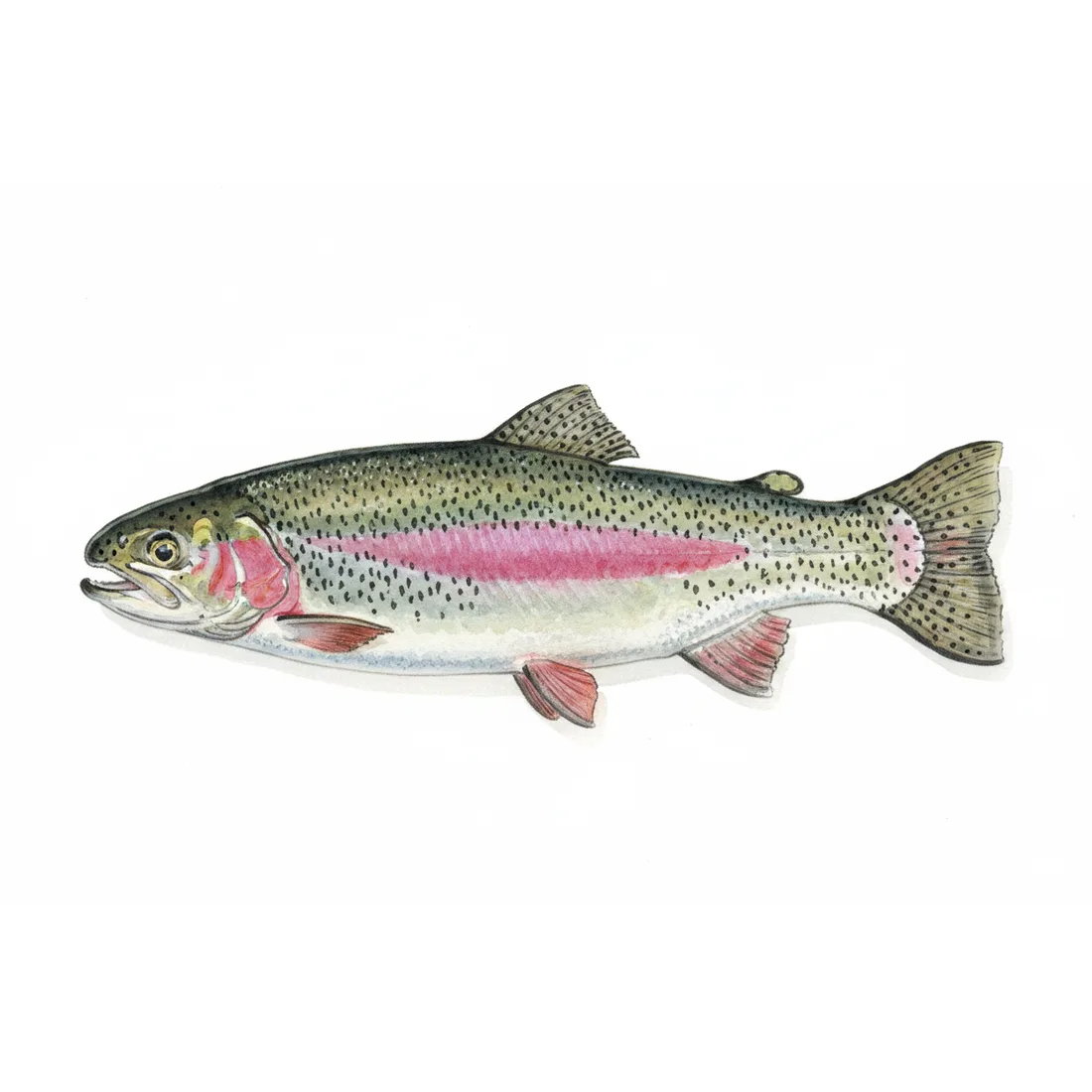
 Illustration· After a photo by Jovana Milanko (CC BY SA 4.0)
Rainbow trout
Oncorhynchus mykiss · Salmonidae
Overview
The rainbow trout is a North American fish that has become one of the mainstays of Irish stillwater fly fishing without ever becoming an Irish fish in the ecological sense. It isn't native here, it doesn't (with a handful of curious exceptions) breed here, and almost every rainbow an Irish angler catches was hatched on a fish farm and stocked into a lake as a put-and-take fishery fish. What makes that arrangement work — biologically and, in Britain, legally — is triploidy: giving the fish a third set of chromosomes so it can never breed, which explains a great deal about how these fisheries are managed and why regulators treat rainbows very differently from wild brown trout.
Life history
Origin
Rainbow trout are native to Pacific-draining river systems of western North America and the far-eastern Russian coast, from Kamchatka down through Alaska and British Columbia to Baja California. They are not native to Ireland, Britain or anywhere in Europe.
Two life-history forms
Most populations are entirely freshwater residents; others are anadromous, migrating to sea as smolts and returning as much larger, more silver steelhead. Steelhead typically spend one to four years in freshwater before smolting, then one to three years at sea. Unlike Pacific salmon, steelhead and rainbow trout generally are iteroparous, though survival to a second spawning is low (commonly cited around 10–20%).
Spawning
Rainbow trout spawn in spring, typically once water temperatures climb into roughly the 6–13°C range — the opposite season to brown trout's autumn spawning. This split is a genuinely useful management fact: a fertile rainbow is digging redds at a time of year that has nothing to do with brown trout spawning behaviour, even where the two coexist in a lake.
Diet and growth
Rainbow trout feed mainly on aquatic invertebrates, taking terrestrial insects, fish eggs and, as they grow, small fish and crustaceans. They tolerate warmer water than brown trout and grow quickly where food is abundant — combined with their amenability to hatchery rearing, this is why they became the default workhorse of put-and-take stillwater fisheries worldwide, Ireland included.
Establishment in Ireland
Rainbow trout first reached Ireland from the United States around 1899–1901, but that attempt failed. A stocking of Lough Shure on Arranmore Island, Co. Donegal, around 1905–1907 succeeded and is the main exception to the "doesn't breed here" rule. A modern commercial rearing stock was established from 1955 with eggs imported from a Surrey (England) trout farm, and that lineage underpins the rainbow trout IFI and private farms now stock into Irish stillwaters.
Triploidy
Almost every stocked Irish rainbow is an all-female triploid (3N) — carrying three chromosome sets instead of the normal two, induced by a pressure or thermal shock applied to the fertilised egg within minutes of fertilisation, which prevents the egg expelling its second polar body. The extra chromosome set disrupts meiosis, making the fish functionally sterile: triploid females show essentially no ovarian development, though triploid males can still develop testes and show some outward signs of maturity even though their sperm isn't viable. The industry therefore usually sex-reverses genetically female fry into "neomale" broodstock (using the hormone 17α-methyltestosterone) so that every resulting offspring is both genetically female and, after the triploidy shock, sterile. Fisheries want sterile fish for three reasons: biosecurity (an escaped fertile stocked fish can't found a breeding population or compete reproductively with wild brown trout), condition (a sterile fish never diverts energy into gonad development or loses condition after spawning, so it holds size and feeding activity later into the season), and no redd-digging or spawning-season disruption.
At a glance
- Scientific name
- Oncorhynchus mykiss (Walbaum, 1792); formerly Salmo gairdneri
- Native range
- Pacific-draining rivers, western North America (Alaska to Baja California) and far-eastern Russia (Kamchatka)
- Status in Ireland
- Non-native; almost entirely a stocked put-and-take fishery fish, not self-sustaining (three known partial exceptions)
- Typical size (stillwater stocked)
- Commonly stocked at ~1–3 lb; larger "specimen" fish farmed to several kg
- Lifespan
- Up to c. 11 years recorded in the wild (native range); stocked fishery fish typically caught within a season or two
- Spawning window
- Spring, roughly once water reaches ~6–7°C into early summer — opposite season to brown trout
- Diet
- Aquatic invertebrates, terrestrial insects, fish eggs, small fish, crayfish; ocean steelhead take fish/squid/amphipods
- Habitat in Ireland
- Almost exclusively small stillwaters (lakes, reservoirs, commercial fisheries); very few Irish rainbow rivers
- Ploidy as typically stocked
- All-female triploid (3N), i.e. sterile
- Conservation status (global, native range)
- IUCN Least Concern overall, though many individual native/wild populations (including some steelhead runs) are threatened
Naming & etymology
- Oncorhynchus mykiss
- Walbaum, 1792. Oncorhynchus is Greek — onkos ("hook, barb") + rhynchos ("snout") — describing the hooked lower jaw male Pacific salmonids develop when breeding. Mykiss comes from mykizha, the local Kamchatkan name used by Walbaum's source material.
- Salmo gairdneri (historical)
- For most of the 20th century the fish was known scientifically as Salmo gairdneri, named by Sir John Richardson in 1836 for Meredith Gairdner, a Hudson's Bay Company surgeon. Genetic work in the late 1980s showed it's more closely related to Pacific salmon than to Atlantic salmon/brown trout, and it was reclassified into Oncorhynchus in 1989.
- Rainbow
- Refers to the broad pink-to-red iridescent band along the flank, most vivid on breeding males.
- Steelhead
- The sea-run form of the same species — a separate common name, not a different species. None of Ireland's stocked fishery rainbows are steelhead.
In Ireland
Rainbow trout reached Ireland from the United States around 1899–1901, but that first attempt failed to establish. Irish rainbow trout populations do not sustain themselves: IFI's own species page states spawning is observed occasionally in stocked waters but has not resulted in long-term self-sustaining populations, and that Irish rainbow fisheries are sustained only by stocking from fish farms. The modern commercial hatchery lineage dates to 1955, when eggs were imported from a Surrey trout farm in England.
The one real exception is Lough Shure, a small acid, peat-bedded bog lake with no inflowing streams on Arranmore Island, Co. Donegal — stocked around 1905–1907, it bred successfully despite having no running water to spawn in. Two further waters, Lough na Leibe (Co. Sligo) and White Lake (Co. Westmeath), developed partial self-sustaining populations with limited natural recruitment. Strikingly, the strain used for these Irish stockings was an autumn/winter-spawning "Shasta" hatchery strain selectively bred for hatchery convenience — yet the descendants in all three naturalised populations reverted to the wild-type spring spawning pattern. This history traces to a single 1984 FAO document; no more recent, authoritative reconfirmation of Lough Shure's present-day breeding status was found, so it should be treated as historically documented rather than a current-tense claim.
IFI operates its own fish farm producing and selling all-female triploid rainbow trout (and all-female triploid brown trout) in nine size grades to angling clubs and private fisheries nationwide, confirming all-female triploid stock as standard Irish practice. No specific published Irish regulatory instrument mandating triploid-only stocking was found (unlike England's Environment Agency policy for farmed brown trout in rivers) — this is confirmed practice, not a confirmed legal mandate. With very few rainbow-trout rivers on the island, Irish rainbow fishing is overwhelmingly a stillwater, put-and-take activity; brown trout remain the native wild fish across Irish lakes and rivers.
On the water
Context, not tactics.
- Because a triploid never enters a spawning cycle, stocked stillwater rainbows tend to hold their condition and feeding activity later into the season than a fertile fish would, instead of running down around a spawning period.
- Triploid males can still show some outward signs of "maturity" (kype, seasonal colour) even though they're sterile — seeing a coloured-up, kyped rainbow in a stillwater doesn't mean the stock policy has failed.
- With almost the entire stocked population already sterile, the practical day-to-day difference this makes on an Irish stillwater is largely academic — it mainly explains why fishery managers can stock through spring and expect fish to stay in good order into summer and autumn.
Key forage
Waters that hold this fish
Sources & how we know this (15)
- Origin/status in Ireland: put-and-take, not self-sustaining; appearance (pink stripe, spotted tail); diet; warm-water tolerance
Inland Fisheries Ireland, species page · 2026-07-09 - IFI fish farm sells all-female triploid rainbow trout and all-female triploid brown trout, nine size grades
Inland Fisheries Ireland, Fish Farm business page · 2026-07-09 - Native range: Pacific drainages, western North America to Kamchatka
USGS Nonindigenous Aquatic Species factsheet · 2026-07-09 - General biology: appearance, size, lifespan, diet, spring spawning at redds, taxonomy history (Salmo mykiss → Salmo gairdneri → Oncorhynchus mykiss), steelhead iteroparity
Wikipedia, "Rainbow trout" · 2026-07-09 - Etymology: Oncorhynchus = hooked snout (Greek); mykiss from Kamchatkan mykizha; Salmo gairdneri named for Meredith Gairdner by Richardson, 1836; reclassification to Oncorhynchus in 1989
Wikipedia "Rainbow trout"; Aquatic Living Resources journal taxonomic-change record · 2026-07-09 - Rainbow trout spawn in spring (opposite brown trout's autumn spawning)
Cross-checked general angling/fisheries sources (search synthesis) · 2026-07-09 - Steelhead is the anadromous form of the same species; life history, iteroparity
NOAA Fisheries / Wild Steelhead Coalition · 2026-07-09 - Triploidy induced by pressure or thermal shock to retain the second polar body; typical pressure parameters; success rate generally >90% but not 100%
Peer-reviewed review literature on triploidy induction methods · 2026-07-09 - Triploid sterility mechanism; triploid males retain some gonadal/behavioural signs, triploid females show minimal gonadal development; welfare trade-offs
"Welfare Considerations of Triploid Fish," Reviews in Fisheries Science & Aquaculture · 2026-07-09 - All-female triploid production via 17α-methyltestosterone sex reversal of females to neomales; industry-standard rainbow trout practice
Peer-reviewed aquaculture literature on sex reversal · 2026-07-09 - England: Environment Agency policy requiring triploid (infertile) farmed brown trout in rivers from 2015, for genetic protection of wild brown trout; triploid rainbow trout long-established in English stillwater stocking
GOV.UK triploid trout publication; Environment Agency blog · 2026-07-09 - Ireland: first rainbow trout introductions 1899–1901 (failed), successful establishment at Lough Shure (Arranmore) 1905–07, modern hatchery lineage from 1955 Surrey eggs, and the three partially self-sustaining Irish waters (Lough Shure, Lough na Leibe, White Lake)
FAO, "The effects of freshwater fish introductions into Ireland" (1984 symposium document — no more recent reconfirmation located) · 2026-07-09 - Irish stockings used an autumn/winter-spawning "Shasta" hatchery strain, but the three naturalised Irish populations reverted to spring (wild-type) spawning
Same FAO 1984 symposium document — single-source finding · 2026-07-09 - Triploid vs diploid rainbow trout: comparable home range, lower emigration and mixed catchability results for triploids across 15 stocked lakes (North American study)
Peer-reviewed study, Movement Ecology / PMC · 2026-07-09 - No published Irish regulatory instrument mandating triploid rainbow trout stocking was located, despite direct checks of IFI's legislation page, the Inland Fisheries Act 2010, and the Fisheries (Amendment) Act 1997 aquaculture-licensing framework
Inland Fisheries Ireland "Our Legislation" page; Irish Statute Book · 2026-07-09
Reference compiled from cited sources — Alex's review pass to come.