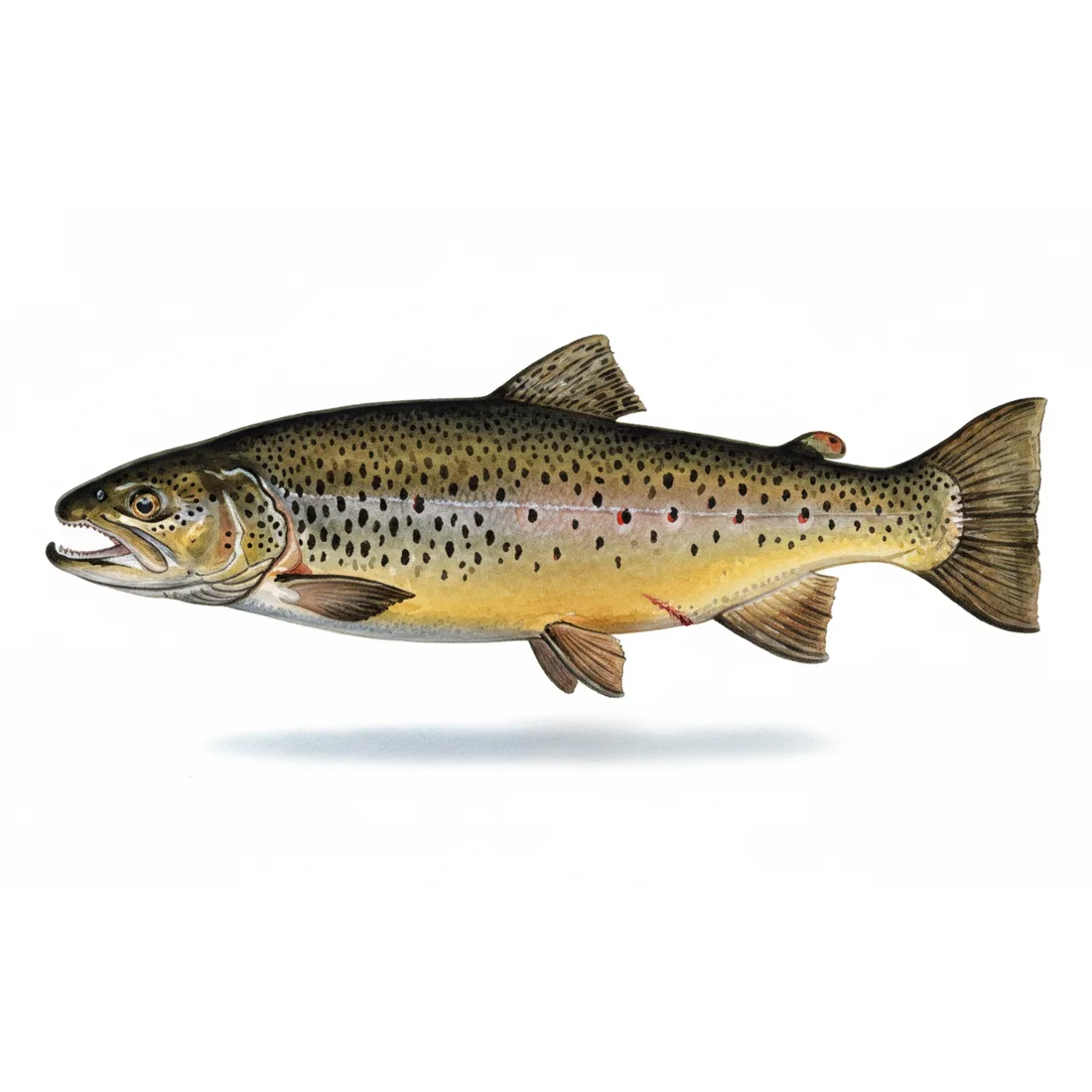
 Illustration· After F. Lydon, "British Fresh Water Fishes" (1879), public domain
Ferox
Salmo trutta · Salmonidae
Overview
The ferox is one of three distinct, reproductively-isolated forms of the brown trout Salmo trutta found together in Lough Melvin, on the Leitrim/Fermanagh border — alongside the gillaroo and the sonaghan. All three share the same lake and the same species but feed in different places, spawn in different places and at different times, and do not interbreed. The ferox is the outlier of the trio: rather than specialising on an invertebrate food source, it's a large, slow-maturing, long-lived piscivorous predator that switches from invertebrates to fish once it reaches a threshold size, growing markedly faster and larger than ordinary brown trout in the same water. It was formerly classified as its own species, Salmo ferox, before 20th-century taxonomy folded all brown trout into Salmo trutta — a historical name only, not a current classification. Unlike the gillaroo and sonaghan, ferox is best understood as a life-history/ecological type as much as a Melvin-specific lineage: genetically similar, piscivorous, long-lived trout occur in numerous other deep, nutrient-poor Irish and Scottish lakes with suitable prey fish, most notably Lough Corrib and Lough Mask.
Life history
Origins
Ferguson & Mason's 1981 allozyme study found the ferox, gillaroo and sonaghan to be genetically distinct, reproductively isolated populations, not simply different-looking trout shaped by diet. A follow-up study (Cawdery & Ferguson, 1988) proposed the ferox is a relict of an early post-glacial colonist, with the gillaroo and sonaghan arising from a later, independent colonisation — all within the roughly 12,000–15,000 years since Ireland deglaciated. A claim that the ferox lineage is as old as 50,000 years, found in one low-quality secondary source, predates the last glaciation and is very likely an error — the peer-reviewed "early post-glacial colonist" framing is the credible account.
Diet and feeding
Ferox switch from invertebrates to fish once they reach a threshold size (reported around 30 cm standard length in general ferox biology, not confirmed as Melvin-specific). Once piscivorous they grow markedly faster and larger than ordinary brown trout in the same water. Diet varies by lake and prey availability: Arctic char and whitefish where present, and in Lough Corrib, documented switching between Arctic char and roach depending on availability.
Growth, size and longevity
Ferox are long-lived, capable of living over 20 years — the oldest confirmed rod-caught record is a 23-year-old Scottish fish from Loch Killin — and reach sizes far beyond typical brown trout: the British rod-caught record ferox is 14.4 kg (31.7 lb), from Loch Awe, Scotland.
Spawning and population
Within Lough Melvin, ferox spawn in the deep, downstream section of the largest inflowing river, the Glenaniff — distinct from the gillaroo (lake margins and the outflow) and the sonaghan (smaller inflowing streams). A 2025 IFI genetic stock identification study, genetically assigning 1,133 adult trout caught between 2001 and 2023 back to their natal spawning rivers, found ferox made up around 14% of the sampled population, nearly all assigned to the Glenaniff — the smallest share of the three forms. The underlying report could not be fully verified in the research behind this record; the figures are internally consistent and specific but worth confirming against the primary document.
At a glance
- Species
- Salmo trutta (historical name Salmo ferox)
- Niche
- Piscivorous predator
- Key diet
- Fish — Arctic char, trout, roach, whitefish where present
- Distinguishing feature
- Deep body, large gape, grows much larger than sympatric brown trout
- Spawning
- Deep section of the largest inflowing river — the Glenaniff
- Share of adult population (IFI genetic study, 2001–2023 samples, published 2025)
- ~14%
- Longevity/size
- Can exceed 20 years; British rod-caught record 14.4 kg / 31.7 lb (Loch Awe, Scotland — not Melvin)
- Found beyond Melvin?
- Yes — a recognised life-history type also in Lough Corrib, Lough Mask, and several Scottish lochs
- IUCN status (as a separate taxon, where assessed)
- Data Deficient
Naming & etymology
- Ferox
- Latin for "fierce" or "wild", a reference to its predatory habit and reputation as a hard-fighting quarry.
- Salmo ferox (historical)
- Named by Jardine, 1835, and later applied more broadly to large piscivorous trout across Britain and Ireland, not only Lough Melvin's population. Dropped out of formal use once brown trout taxonomy was consolidated under Salmo trutta; unlike gillaroo and sonaghan, ferox is currently assessed by IUCN as Data Deficient rather than as a standalone Vulnerable taxon.
In Ireland
Lough Melvin sits on the Leitrim (Republic of Ireland) / Fermanagh (Northern Ireland) border and is not managed by the Loughs Agency, whose statutory remit is limited to the Foyle and Carlingford catchments — Melvin drains west via the Drowes to Donegal Bay, outside both. On the Republic side, Inland Fisheries Ireland is the relevant authority; on the Northern Ireland side, angling licensing sits with DAERA, with day-to-day fishing rights on the "Northern Waters" held by the Garrison and Lough Melvin Angling Association (GLMAA, formed 1976).
Unlike gillaroo and sonaghan, ferox are not unique to Melvin — the same piscivorous, long-lived life-history type is a recognised feature of other big Irish loughs, most notably Corrib and Mask, which between them hold the large majority of Ireland's recorded specimen ferox trout. A 2021 peer-reviewed radio-tracking study (Gargan et al.) found that the great majority of ferox tagged in Corrib and Mask converge on a very small number of spawning sites — 92% of Corrib fish and 76% of Mask fish spawning in the Cong River/Cong Canal system — a narrow bottleneck that leaves the whole stock vulnerable to a single point of failure, and the reason ferox conservation is an active Irish fisheries-management issue beyond Melvin. Melvin itself is internationally significant as the only scientifically documented case of brown trout showing this degree of complete, stable reproductive isolation between sympatric forms within one lake — see also the gillaroo and sonaghan records, and Lough Melvin's own endemic, Critically Endangered Arctic char.
On the water
Context, not tactics.
- The existence of three ecologically distinct trout in one lake is a useful mental model for Irish stillwater fishing generally: a single lough can contain, in the right deep, prey-rich water, a minority of fish hunting other fish outright, as ferox do.
- Anglers on Melvin target the three forms somewhat differently, reflecting their different niches — but the specific methods belong to the engine's rule system, not to this natural-history record.
- Because ferox occur well beyond Melvin — notably in Corrib and Mask — this record's angling relevance extends further than the gillaroo's or sonaghan's, which are Melvin-only; but tactics for any of the three remain the engine's domain, not this record's.
Key forage
Waters that hold this fish
Sources & how we know this (10)
- Three genetically distinct, reproductively isolated brown trout forms in Lough Melvin; allozyme evidence
Ferguson, A. & Mason, F.M. (1981), Journal of Fish Biology 18(6), 629–642 · 2026-07-09 - Origins via separate post-glacial colonisation events; ferox as early relict colonist, gillaroo/sonaghan as later independent colonisation
Cawdery, S.A.H. & Ferguson, A. (1988), Polskie Archiwum Hydrobiologii 35, 267–277 · 2026-07-09 - Ferox spawning-site fidelity and vulnerability, Lough Corrib & Lough Mask (radio-tracking): 92% of Corrib fish, 76% of Mask fish spawn in the Cong River/Cong Canal system
Gargan, P. et al. (2021), Journal of Fish Biology, DOI 10.1111/jfb.14593 · 2026-07-09 - Ferox reproductive isolation, Scottish lochs (Awe, Laggan) — existence/topic confirmed, not independently read in full
Duguid, R.A. et al. (2006), Journal of Fish Biology · 2026-07-09 - Ferox species biology, diet, distribution, spawning, conservation (Ireland)
Inland Fisheries Ireland, "Ferox trout (Salmo ferox)" · 2026-07-09 - Ferox life history, age, size, growth, diet, UK/Ireland distribution, conservation; British rod-caught record 14.4 kg (31.7 lb), Loch Awe; 23-year-old rod-caught record, Loch Killin
Wild Trout Trust, "Ferox Trout" · 2026-07-09 - Ferox etymology, physical description, diet shift, distribution, IUCN status
Wikipedia, "Ferox trout" · 2026-07-09 - 2025 IFI genetic stock ID study (1,133 fish, 2001–2023): sonaghan 67%/gillaroo 19%/ferox 14%, named spawning rivers — recovered via search-indexed snippet, not a direct PDF read; verify before publishing
Inland Fisheries Ireland, "Population Structure and Genetic Stock Identification of the Lough Melvin Trout" · 2026-07-09 - Loughs Agency statutory remit limited to Foyle and Carlingford catchments only — does not extend to Lough Melvin
DAERA (Department of Agriculture, Environment and Rural Affairs, Northern Ireland) · 2026-07-09 - Lough Melvin general facts (location, size, three trout forms, char)
Wikipedia, "Lough Melvin" · 2026-07-09
Reference compiled from cited sources — Alex's review pass to come.