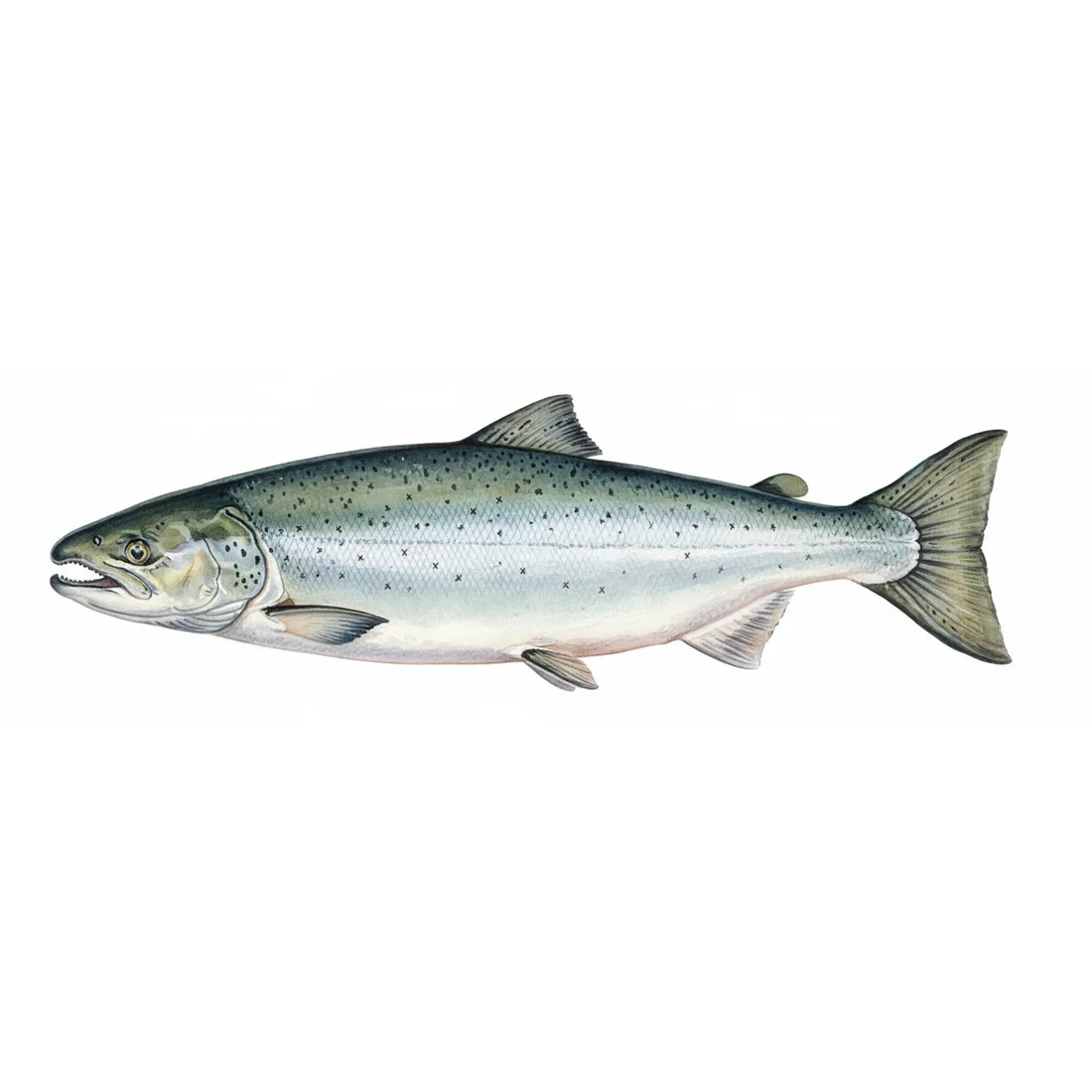
 Illustration· After a photo by Hans-Petter Fjeld (CC BY SA 2.5)
Atlantic salmon
Bradán · Salmo salar · Salmonidae
Overview
The Atlantic salmon is Ireland's most storied fish and the reason fly fishing exists as a sport here: an anadromous salmonid born in freshwater that migrates thousands of kilometres to feed in the North Atlantic before returning — not feeding, against all commercial logic — to the river it hatched in to spawn and very often die. Wild Irish stocks have collapsed by roughly 90% since the 1970s, and most Irish salmon rivers are now closed or catch-and-release only; understanding the life cycle explains why closed seasons, spring-fish protection and catch-and-release rules exist at all.
Life history
Egg (ova)
Spawning takes place in Irish rivers November–January, on gravel redds the female cuts with her tail in 15–30 cm of water. A large female (over 10 kg) may lay around 15,000 eggs. Eggs incubate over winter at a rate set by water temperature, hatching in Irish rivers typically in spring.
Alevin (yolk-sac fry)
Newly hatched alevins stay in the gravel for several weeks, nourished by an attached yolk sac. As it's absorbed they become mobile and undertake "swim-up" to the open water column, gulping air to inflate the swim bladder — a physiologically important, predator-exposed transition.
Fry
Once free-swimming and feeding independently, usually through their first summer, young salmon hold station in fast, well-oxygenated riffle habitat, feeding on aquatic invertebrates and developing the camouflage patterning of parr.
Parr
By their first autumn, fry develop dark vertical "parr marks" and spotting for camouflage in gravel-bed streams. Parr are strongly territorial in fast water. Freshwater residence commonly runs 1–3 years in Ireland's relatively warm, productive rivers, so the smolt run is a mix of age classes rather than one cohort.
Smoltification
In spring, parr reaching roughly 10–25 cm undergo smoltification: a hormonal and physiological switch preparing a freshwater fish for the sea. The fish "silvers" as parr marks are masked by guanine deposition; internally, gill chloride cells and Na⁺/K⁺-ATPase activity rise sharply, reversing the fish's ion-regulation from retaining salts to excreting them, driven by a cortisol/growth-hormone surge triggered by daylength and temperature. This window is also understood to be a critical olfactory imprinting period, when juveniles imprint on their natal water's chemical signature.
Marine migration and feeding
Smolts migrate out to the North Atlantic, historically concentrated around the Faroes, West Greenland and the Norwegian Sea, though tagging has shown salmon ranging further into the Barents Sea. At sea they are opportunistic predators, feeding on capelin, herring, sandeels and crustaceans. This is the phase where almost all adult body mass is put on — and where most natural and human-caused mortality now occurs.
Return: grilse vs multi-sea-winter salmon
Grilse return after a single winter at sea, typically smaller (roughly 1.5–4 kg), and form Ireland's main summer run. Multi-sea-winter (MSW) salmon, including the prized "spring fish", spend two or more winters at sea and return larger, some entering Irish rivers very early in the year, months before spawning. Salmon do not feed once back in fresh water — they live off fat reserves and the gut atrophies. Why a non-feeding fish still takes a fly or lure is genuinely unresolved in the literature; the leading, non-exclusive hypotheses are a residual/reflexive feeding response, territorial aggression or irritation, and general curiosity — none is definitively proven over the others.
The upstream run
Fish move upriver in response to adequate flow — a "spate" is frequently the trigger that lets fish push past shallow water, weirs and falls. Salmon navigate using olfactory cues, the earth's magnetic field for the oceanic phase, and rheotaxis for the final approach. Irish run timing broadly falls into three river-dependent windows: spring salmon (Jan–Apr, the earliest MSW fish), summer grilse (building through June, peaking July), and a now much-reduced autumn run (Aug–Sept).
Spawning
Fish that have held in the river for months (spring fish) or weeks (grilse/autumn fish) move onto spawning gravels in headwater tributaries from November into January, restarting the cycle.
Kelts and repeat spawning
A spent post-spawning salmon is a kelt — emaciated after months of fasting and the energy cost of migration and spawning. Most kelts die, but a minority survive to recondition at sea and return to spawn again (repeat spawning/iteroparity). General Atlantic-wide syntheses put repeat-spawner rates at an average of around 11% (Fleming 1998, range 1–43%) to around 5% (a more recent 10-population NW Atlantic survey, range 0–24.7%) — no Ireland-specific figure was found. Body condition at spawning strongly predicts overwinter and marine survival.
At a glance
- Scientific name
- Salmo salar Linnaeus, 1758
- Family
- Salmonidae
- Irish name
- Bradán
- Life history
- Anadromous; facultatively iteroparous (usually semelparous in practice)
- Freshwater juvenile phase
- Typically 1–3 years in Ireland as parr, before smolting
- Marine phase
- 1 winter (grilse) to 2+ winters (MSW/spring salmon) at sea
- Typical adult size
- Grilse ~1.5–4 kg; MSW/spring fish often 4 kg+, occasionally into double figures
- Spawning window (Ireland)
- November–January
- Feeding in freshwater (return run)
- None — lives on stored fat; gut atrophies
- Conservation status (Ireland)
- Severely depleted; most rivers below Conservation Limit
- Legal protection
- Annex II species, EU Habitats Directive; many Irish salmon rivers designated Special Areas of Conservation (SAC)
Naming & etymology
- Salmo salar
- Latin; Salmo is the classical word for salmon, widely (though not certainly) linked to salire, "to leap" — giving the popular gloss "the leaper", a nod to the fish jumping falls and weirs on its upstream run. Named by Linnaeus, 1758.
- Bradán
- Irish name, predating scientific taxonomy; cognate with Scottish Gaelic bradan. Central to Irish river culture and folklore — see the salmon of knowledge (bradán feasa).
- Grilse
- A salmon returning after only one winter at sea (a "one-sea-winter"/1SW fish). Origin genuinely obscure — traced to Middle English grils(e), possibly linked to Old French grisel ("grey"), but no single derivation is agreed.
- King of Fish
- Traditional English epithet reflecting size, fighting quality and historic status as the prize catch of European rivers — not a taxonomic term.
In Ireland
Ireland's wild Atlantic salmon are in severe, well-documented decline. Adult returns are estimated to have fallen from roughly 1.7 million fish in the 1970s to fewer than 150,000 today — a decline in the region of 90%. Inland Fisheries Ireland assesses 144 individually designated salmon rivers each year against river-specific Conservation Limits, on advice from the all-island Technical Expert Group on Salmon (TEGOS). The trend is worsening: for the 2026 season TEGOS classified only 41 rivers as having a harvestable surplus, 29 as catch-and-release only, and 74 as closed — meaning fewer than a third of Ireland's salmon rivers currently carry any harvestable surplus at all. 2023 produced the lowest recorded returns on record, with 2025 ranking third-lowest.
Marine survival is identified as the primary driver of the decline — the proportion of smolts surviving to return as adults has fallen from a historical 15–20% to around, or below, 5% in recent years. Among the marine and coastal pressures with the strongest evidence base for Ireland specifically is sea lice from open-net salmon farming on the west coast: a ~30-year IFI monitoring study on the Erriff river system (Co. Mayo), adjacent to salmon farming in Killary Harbour, found sea lice infestation associated with reductions in wild salmon returns of up to roughly 50%, with even larger impacts on sea trout in the same system.
In response, IFI/the Department proposed the most significant tightening of conservation measures since 2006 for the 2026 season, including a bag limit restricted to a mid-season window with catch-and-release mandated outside it to protect early-running spring fish. Exact seasons, bag limits and byelaws are river-specific, change annually, and should always be sourced live from IFI/gov.ie rather than restated here. Atlantic salmon is listed on Annex II of the EU Habitats Directive (freshwater only), and major Irish salmon systems including the River Moy and the Corrib system are designated Special Areas of Conservation partly for their salmon populations. Other historically significant Irish salmon rivers include the Blackwater (Munster), the Laune, and the Foyle catchment rivers managed cross-border by the Loughs Agency.
On the water
Context, not tactics.
- Because salmon are not feeding on the return run, salmon fly fishing rests on triggering a non-feeding response (reflex, territoriality, curiosity) rather than imitating a food item — a fundamentally different problem from presenting a fly as prey.
- Run timing is governed by water: a spate that raises and colours the river is frequently what allows fish to move upstream past obstacles, and "fresh" (recently arrived) fish behave differently to fish that have held for a period in the same pool.
- The distinction between spring fish (present for months before spawning) and grilse/autumn fish (present for a much shorter window) is a live factor in conservation measures, given spring fish are proportionately more vulnerable and now the rarer category.
- Kelts (spent fish) are legally protected from targeting/retention at the relevant time of year and are recognisably different in condition from a fresh-run fish.
- Adult salmon do not feed in fresh water, so they have no forage profile in the way trout or char do — this is a defining fact about the species, not a gap in this record.
Waters that hold this fish
Sources & how we know this (23)
- Life-cycle stages (egg→alevin→fry→parr→smolt→marine→return→kelt); spawning Nov–Jan; redd depth; ~15,000 eggs per 10kg female; marine diet; grilse vs MSW definitions
Marine Institute, "Salmon Life Cycle" · 2026-07-09 - Ireland-wide return collapse (~1.7m in 1970s to <150,000 today); 144 salmon rivers; 2026 TEGOS split (41 harvestable/29 catch-and-release/74 closed); 2023 lowest on record, 2025 third-lowest; marine survival ~15–20% historically to ~5% or below now
Salmon Watch Ireland press release, Nov 2025 (citing IFI/TEGOS assessment) · 2026-07-09 - Primary corroboration of the 2025 and 2026 TEGOS river-status splits
Department of Climate, Energy and the Environment (gov.ie) press releases · 2026-07-09 - 2026 conservation measures: harvest window restricted to Jun 1–Aug 31, catch-and-release outside that window; bag-limit figure changed mid-consultation, so not restated here
Inland Fisheries Ireland, "Proposed New Salmon Conservation Measures for 2026" · 2026-07-09 - Wild salmon decline context, marine survival as primary driver
The Irish Times, "Wild salmon are on the brink of disappearing from Irish waters" (Ella McSweeney), 28 June 2025 · 2026-07-09 - Sea lice from salmon farming linked to up to ~50% reduction in wild Atlantic salmon returns; Erriff river (Co. Mayo) ~30-year IFI study
Inland Fisheries Ireland media release · 2026-07-09 - Peer-reviewed confirmation: salmon lice from aquaculture reduce marine survival of Atlantic salmon
Gargan et al., Journal of Animal Ecology, 2025 · 2026-07-09 - Sea lice impact context — sea trout up to ~90% marine survival reduction in some areas
Salmon Watch Ireland, "Sea Lice — Aquaculture's Silent Killer" · 2026-07-09 - Smoltification physiology: silvering, gill chloride cells, Na+/K+-ATPase activity, cortisol/GH-IGF-1 hormonal drivers
Peer-reviewed smoltification physiology literature (aggregated) · 2026-07-09 - Olfactory imprinting during parr–smolt transformation as the primary homing mechanism
PMC, "Empirical support for sequential imprinting during downstream migration in Atlantic salmon smolts" · 2026-07-09 - Additional embryonic-stage imprinting window evidence
Armstrong et al., Ecology of Freshwater Fish, 2022 · 2026-07-09 - Marine feeding grounds extending beyond Faroes/Greenland/Norwegian Sea into Barents Sea and Arctic frontal zones
Scientific Reports (Nature), "Redefining the oceanic distribution of Atlantic salmon" · 2026-07-09 - Stable-isotope evidence for South European salmon marine feeding grounds in Greenland
ICES Journal of Marine Science · 2026-07-09 - Kelt survival and repeat spawning: nutritional condition predicts overwinter/marine survival
Conservation Physiology (Oxford Academic) · 2026-07-09 - Repeat-spawning (iteroparity) rate synthesis: Fleming 1998 avg 11% (range 1–43%); more recent 10-population NW Atlantic survey avg ~5% (range 0–24.7%)
Kaland et al., Evolutionary Applications, 2023 (PMC) · 2026-07-09 - Checked for an Ireland-specific repeat-spawning/kelt-survival figure: none found; Burrishoole records kelt lengths/counts but no published percentage surfaced
Marine Institute, Burrishoole research-station dashboard/site · 2026-07-09 - Scientific name meaning ("the leaper"), Linnaeus 1758 attribution
Atlantic Salmon Trust, "Salmo Salar — 'The Leaper'" · 2026-07-09 - Grilse etymology (Middle English grils(e), uncertain origin, possible Old French grisel link)
Merriam-Webster; Wiktionary · 2026-07-09 - Atlantic salmon listed on Annex II, EU Habitats Directive (freshwater only)
JNCC, Special Areas of Conservation species page S1106 · 2026-07-09 - River Moy SAC and Lough Corrib SAC designated partly for Atlantic salmon
NPWS site synopses SY002298 and SY000297 · 2026-07-09 - Irish run-timing pattern context (spring salmon Jan–Apr, grilse building June–peaking July, historic autumn run)
Blackwater Trout & Salmon Fishery, "Runs of Salmon" (angling literature, context only) · 2026-07-09 - "Why salmon take a fly" — competing hypotheses (reflex/feeding memory, territorial aggression, curiosity), unresolved in the literature
Aggregated angling-science sources (not peer-reviewed) · 2026-07-09 - Irish/Gaelic name "bradán"/"bratan"
Cross-checked general Gaelic-language dictionary sources · 2026-07-09
Reference compiled from cited sources — Alex's review pass to come.