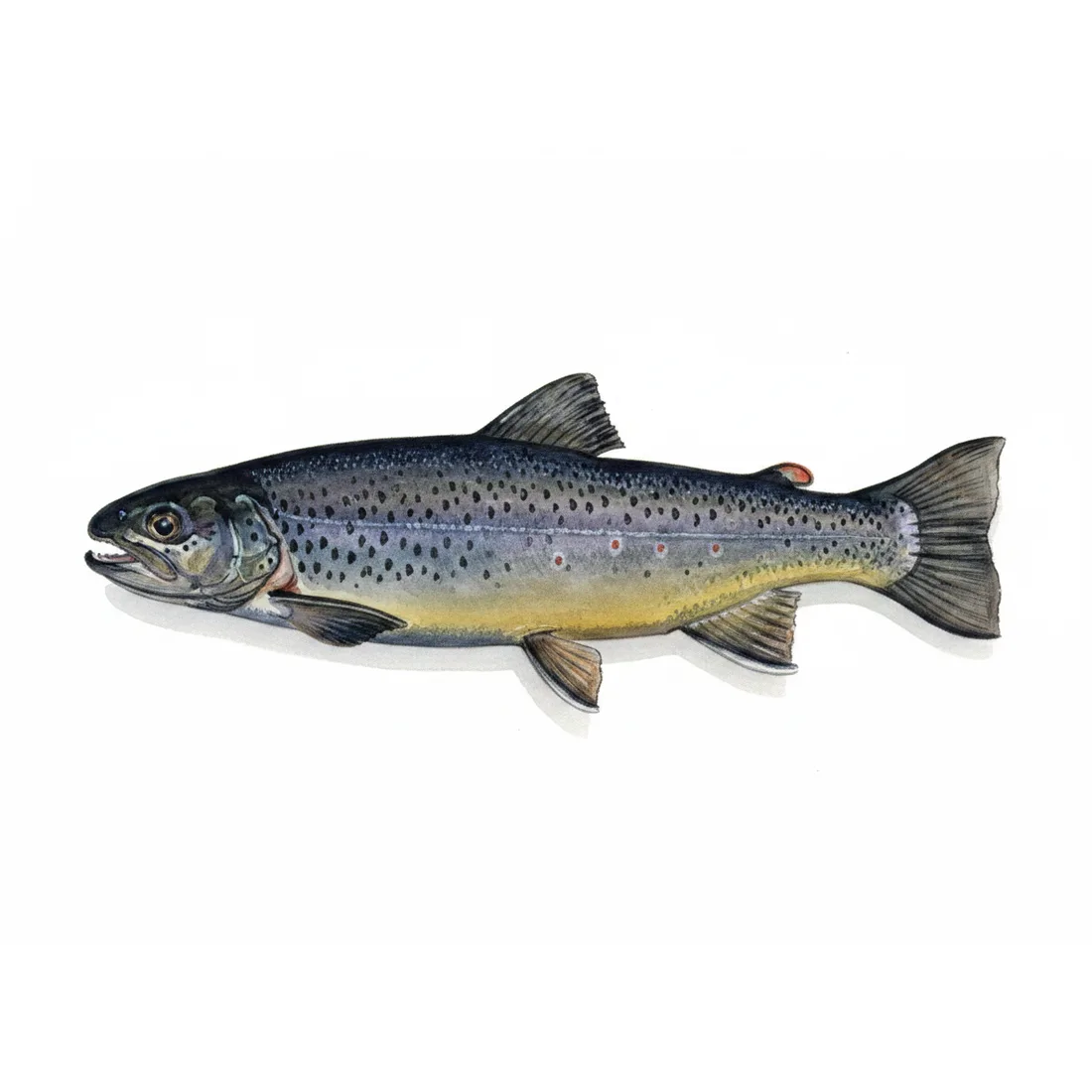
 Illustration· After a photo by Caught by Lars Olaf Simonsen (CC BY SA 3.0)
Sonaghan
Salmo trutta · Salmonidae
Overview
The sonaghan is one of three distinct, reproductively-isolated forms of the brown trout Salmo trutta found together in Lough Melvin, on the Leitrim/Fermanagh border — alongside the gillaroo and the ferox. All three share the same lake and the same species but feed in different places, spawn in different places and at different times, and do not interbreed. The sonaghan is the pelagic, open-water specialist of the trio — a slim, silvery, dark-finned plankton feeder that is, by numbers, the dominant form in the lough. It was formerly classified as its own species, Salmo nigripinnis, before 20th-century taxonomy folded all brown trout into Salmo trutta — a historical name only, not a current classification.
Life history
Origins
Ferguson & Mason's 1981 allozyme study found the sonaghan, gillaroo and ferox to be genetically distinct, reproductively isolated populations, not simply different-looking trout shaped by diet. A follow-up study (Cawdery & Ferguson, 1988) proposed the sonaghan and gillaroo arose from a later, independent post-glacial colonisation event separate from the ferox — all within the roughly 12,000–15,000 years since Ireland deglaciated.
Diet and feeding
The sonaghan roams the deeper, open body of the lough rather than hugging bottom or margin, feeding on zooplankton — water fleas (Cladocera, principally Daphnia) — plus midge (chironomid) pupae. Because Daphnia itself moves vertically in the water column in response to light, sinking deeper in bright conditions, sonaghan are reported to track their food source deeper on sunny days — a plausible but not independently confirmed inference for Melvin specifically.
Physical form and behaviour
Sonaghan are slimmer and more streamlined than gillaroo, with a light-brown-to-silver body carrying large, dark spots and notably dark, elongated fins (hence nigripinnis, "black-finned"). They shoal in open water and are reported in angling literature to fight disproportionately hard for their size.
Spawning and population
Sonaghan spawn in the smaller rivers and streams flowing into the lough, principally the Tullymore and Ballagh — distinct from the gillaroo (lake margins and the outflow) and the ferox (the deep section of the largest inflow, the Glenaniff). A 2025 IFI genetic stock identification study, genetically assigning 1,133 adult trout caught between 2001 and 2023 back to their natal spawning rivers, found sonaghan made up around 67% of the sampled population — by far the numerically dominant form — with the Tullymore (31%) and Ballagh (24%) as the dominant source rivers. The underlying report could not be fully verified in the research behind this record; the figures are internally consistent and specific but worth confirming against the primary document.
At a glance
- Species
- Salmo trutta (historical name Salmo nigripinnis)
- Niche
- Pelagic / open-water, plankton specialist
- Key diet
- Daphnia (water fleas) and other zooplankton, chironomid pupae
- Distinguishing feature
- Dark, elongated fins; slim, silvery build
- Spawning
- Small inflowing streams, principally the Tullymore and Ballagh
- Share of adult population (IFI genetic study, 2001–2023 samples, published 2025)
- ~67% — the numerically dominant form
- Found beyond Melvin?
- Not confirmed elsewhere — Lough Melvin is the only proven population
- IUCN status (as a separate taxon, where assessed)
- Vulnerable (Freyhof & Kottelat, 2008)
Naming & etymology
- Sonaghan (sonaghen)
- The vernacular name is widely used in the angling and scientific literature around Lough Melvin, but a confirmed Irish-language root was not found in the sources behind this record — treat any etymology offered for "sonaghan" itself as unconfirmed.
- Salmo nigripinnis (historical)
- Named by Günther, 1866. Nigripinnis is Latin/Greco-Latin for "black-finned", describing its dark, elongated fins. Dropped out of formal use once brown trout taxonomy was consolidated under Salmo trutta; some IUCN assessments still treat it as a standalone species (assessed Vulnerable), while Irish and UK fisheries authorities classify it as a form of Salmo trutta — a live taxonomic debate, not a settled question.
In Ireland
Lough Melvin sits on the Leitrim (Republic of Ireland) / Fermanagh (Northern Ireland) border and is not managed by the Loughs Agency, whose statutory remit is limited to the Foyle and Carlingford catchments — Melvin drains west via the Drowes to Donegal Bay, outside both. On the Republic side, Inland Fisheries Ireland is the relevant authority; on the Northern Ireland side, angling licensing sits with DAERA, with day-to-day fishing rights on the "Northern Waters" held by the Garrison and Lough Melvin Angling Association (GLMAA, formed 1976).
The sonaghan, like the gillaroo, is found nowhere else with genetic confirmation — Lough Melvin is its only proven population, and by the 2025 IFI genetic study it's the numerically dominant of the three forms, making up roughly two-thirds of the sampled adult population. Melvin is internationally significant as the only scientifically documented case of brown trout showing this degree of complete, stable reproductive isolation between sympatric forms within one lake — see also the gillaroo and ferox records, and Lough Melvin's own endemic, Critically Endangered Arctic char.
On the water
Context, not tactics.
- The existence of three ecologically distinct trout in one lake is a useful mental model for Irish stillwater fishing generally: a single lough can hold fish under genuinely different feeding pressures at the same time, some working open water on plankton and midge like the sonaghan.
- Anglers on Melvin target the three forms somewhat differently, reflecting their different niches — but the specific methods belong to the engine's rule system, not to this natural-history record.
- The sonaghan's open-water, plankton-tracking habit and reported hard-fighting reputation are the biological reason it behaves differently on the water from the bottom-feeding gillaroo or the fish-eating ferox in the same lake.
Key forage
Waters that hold this fish
Sources & how we know this (6)
- Three genetically distinct, reproductively isolated brown trout forms in Lough Melvin; allozyme evidence
Ferguson, A. & Mason, F.M. (1981), Journal of Fish Biology 18(6), 629–642 · 2026-07-09 - Origins via separate post-glacial colonisation events; ferox as early relict colonist, gillaroo/sonaghan as later independent colonisation
Cawdery, S.A.H. & Ferguson, A. (1988), Polskie Archiwum Hydrobiologii 35, 267–277 · 2026-07-09 - Sonaghan/Salmo nigripinnis description, diet, habitat, IUCN status
Wikipedia, "Sonaghen" · 2026-07-09 - 2025 IFI genetic stock ID study (1,133 fish, 2001–2023): sonaghan 67%/gillaroo 19%/ferox 14%, named spawning rivers — recovered via search-indexed snippet, not a direct PDF read; verify before publishing
Inland Fisheries Ireland, "Population Structure and Genetic Stock Identification of the Lough Melvin Trout" · 2026-07-09 - Loughs Agency statutory remit limited to Foyle and Carlingford catchments only — does not extend to Lough Melvin
DAERA (Department of Agriculture, Environment and Rural Affairs, Northern Ireland) · 2026-07-09 - Lough Melvin general facts (location, size, three trout forms, char)
Wikipedia, "Lough Melvin" · 2026-07-09
Reference compiled from cited sources — Alex's review pass to come.