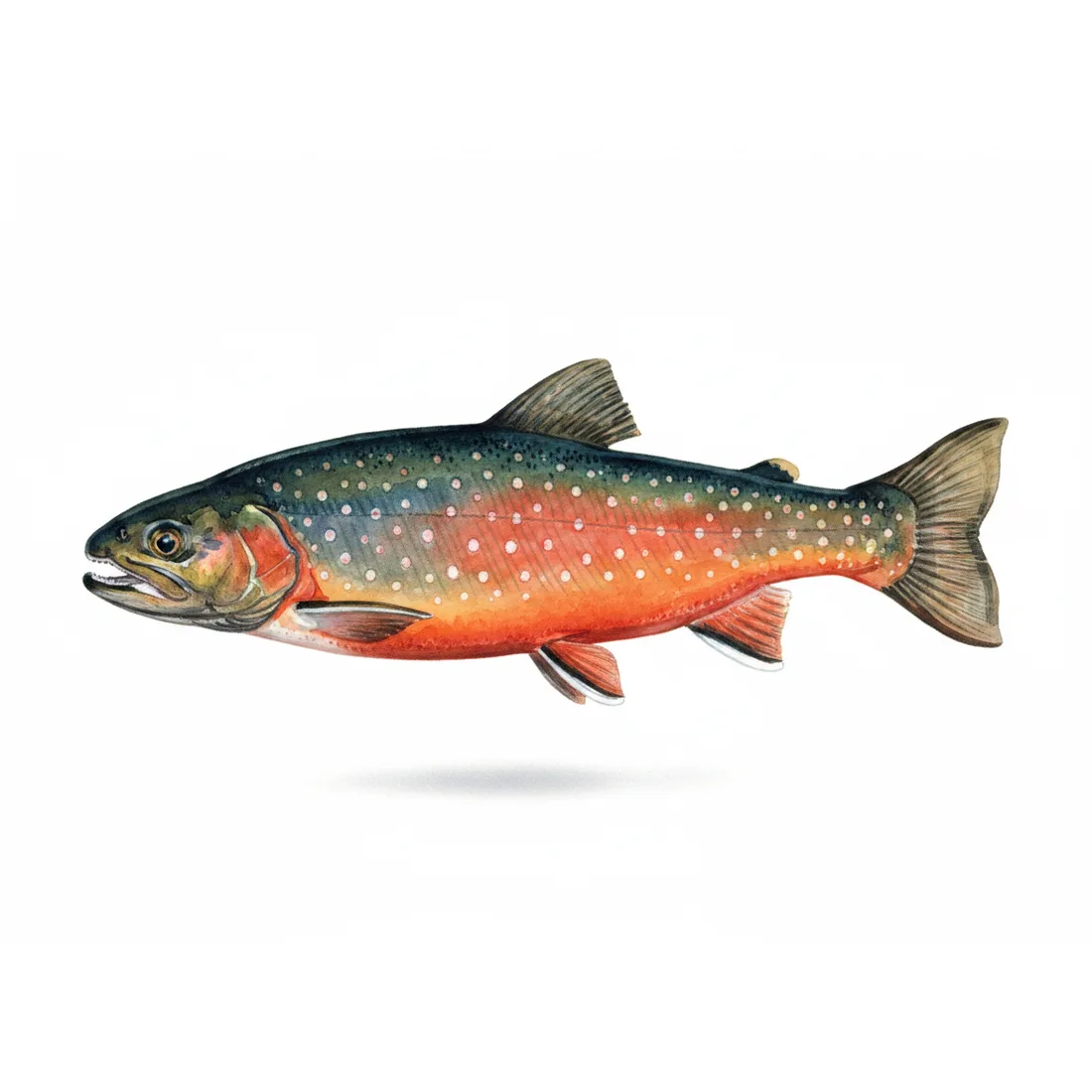
 Illustration· After a photo by Nils Rinaldi (CC BY 2.0)
Arctic char
Muírnín · Salvelinus alpinus · Salmonidae
Overview
The Arctic char is a glacial relict — a cold-water fish stranded in Ireland's deepest, coldest loughs when the ice sheets retreated roughly 18,000 years ago, and never able to get back to the sea or the Arctic since. It isn't a trout at all: it belongs to a separate genus, Salvelinus, alongside brook char and lake char. Char are the world's most northerly-distributed freshwater fish, but Ireland's populations are landlocked survivors far south of that main range, each isolated in its own lough since the ice age and, as a result, subtly different from the next — biologists rank char as the most variable ("polymorphic") vertebrate on Earth, and Ireland's isolated populations have taken that to an extreme, producing named local forms found nowhere else in the world. For an Irish fly angler, char matter less as a target species — most populations are essentially uncatchable by fly — and more as a marker of water quality: char need cold, oxygen-rich, unpolluted deep water, and where they are declining or gone, that's usually a signal about the lough itself.
Life history
Annual cycle
For roughly ten months of the year, Irish char sit in deep water — generally more than 10 m down, and in the endemic Melvin form recorded at 10–30 m — where temperatures stay cold and stable. This is a specialisation, not a preference of convenience: char eggs need water below about 8°C to develop, and adult char are outcompeted by brown trout in warmer, shallower water.
Feeding
Char are principally planktivorous — the dominant food is zooplankton (water fleas / Cladocera), with aquatic insect larvae taken occasionally. This is a key reason char are hard to catch on a fly: their staple diet is minute, drifting and taken by sight in open water at depth, not the kind of prey a surface or near-surface fly imitates.
Spawning
Irish char spawn in autumn/early winter, moving out of deep water into shallow rocky or gravelly margins, generally October–December, though site-specific timing varies (Lough Melvin's form spawns in November; Coomasaharn's in November/December). At least one Irish population (Lough Talt) is suspected — though not confirmed — of having both an autumn-spawning and a spring-spawning group sharing one lough. Unlike Pacific salmon, char are iteroparous — they survive spawning and can breed in multiple years.
Growth and lifespan
Growth is slow in Ireland's cold, low-productivity loughs. In Lough Melvin, char show little extra growth after about three years old, which is also when they reach maturity; the maximum recorded age there is nine years, and the largest fish ever recorded from netting survey was 27 cm and 200 g — modest compared with Arctic populations, where char grow much larger and live longer in food-richer or less competitive water.
At a glance
- Scientific name
- Salvelinus alpinus (Linnaeus, 1758)
- Family
- Salmonidae (genus Salvelinus — a char, not a trout)
- Irish status
- Native; glacial relict, landlocked since the last ice age (~18,000 years ago)
- IUCN global status
- Least Concern (species-wide) — masks severe local decline in peripheral populations like Ireland's
- Irish status (Red Data Book)
- Vulnerable
- Typical adult size (Ireland)
- c. 18–27 cm reported across surveyed Irish loughs; largest Melvin fish on record 27 cm/200 g
- Lifespan
- Up to c. 9 years recorded (Lough Melvin); growth slows from age 3
- Spawning
- Autumn/early winter, chiefly October–December; shallow rocky/gravel margins; requires water below ~8°C
- Habitat
- Deep (>10 m), cold, oxygen-rich, oligotrophic loughs; spends most of the year below the thermocline
- Diet
- Zooplankton (chiefly), some insect larvae
- Known Irish range
- Historically up to c. 70 loughs; roughly a third of populations believed lost. Strongholds: Donegal (≥15 population records), west Kerry/Killarney, scattered western loughs, Lough Melvin
Naming & etymology
- Salvelinus alpinus
- Linnaeus, 1758. Salvelinus derives from the German Saibling, "little salmon"; alpinus means "of the mountains/Alps", reflecting the species' cold, high-altitude and high-latitude habitat preference.
- Char / charr
- Generally traced to Old Irish ceara/cera, "[blood-]red", a reference to the fish's vivid red-to-orange belly, especially in spawning males. The Welsh name torgoch means the same thing — "red belly" — a cognate pattern across the Insular Celtic languages. "Charr" is the older British/Irish spelling; "char" is now more common.
- Irish names
- The Irish Char Conservation Group gives four: Muírnín, hobbin, Ruadh-bhreac ("red trout/char") and Breac buidhe ("yellow trout"). Muírnín is otherwise a general Irish term of endearment ("darling"), so its use as a fish name is unusual; sourced from a single specialist body, not independently corroborated.
- Salvelinus grayi / Salvelinus fimbriatus (historical)
- The Lough Melvin population, locally called "freshwater herring", was once classified as its own species, Salvelinus grayi ("Gray's char"), named by Albert Günther in 1862. The Lough Coomasaharn (Kerry) population was similarly described as Salvelinus fimbriatus ("fringed char") by Regan in 1908. Modern genetics treats Irish char as forms of S. alpinus rather than true separate species, but the historical names persist in the literature and local usage.
In Ireland
Arctic char have been recorded in as many as 70 Irish loughs, but roughly a third of known Irish char populations are believed extinct, principally from pollution/eutrophication, introduced non-native fish (historically pike, more recently rudd, roach and zebra mussel), habitat disturbance, acidification and climate warming. Char are recorded as extinct in Lough Neagh by around 1844 and in Lough Erne by the early twentieth century; more recently they've been lost from Lough Corrib and Lough Conn within roughly the last 25 years, and from at least three lakes in Co. Clare. Char were also recorded historically in the midlands and along the east coast, including Lough Owel (Co. Westmeath), where they reportedly reached weights of up to 1.4 kg — never confirmed by proper study because the population died out first.
Char persist mainly in deep, cold, oligotrophic mountain and corrie loughs down the west of Ireland. Lough Melvin (Leitrim/Fermanagh border) holds the endemic form historically classified as Salvelinus grayi, the only confirmed Northern Ireland population and a conservation flashpoint — one assessment put the population at 33 individuals in 1975, falling to just 12 by 2001, with phosphorus-sensitivity, eutrophication and competition from introduced rudd and roach cited as drivers; IUCN lists it Critically Endangered under its historic species-level classification. County Donegal holds at least 15 recorded char populations, the highest concentration of any Irish county, including Kindrum Lough, Ireland's most northerly char population, where there's active concern over water abstraction. The Kerry/Killarney lakes hold several populations, including Lough Coomasaharn, whose form (once classified as Salvelinus fimbriatus) has an unusually high gill-raker count and was found to be the dominant fish species in the lake, ahead of brown trout. Char are also reported in smaller numbers from Caragh Lake and Lough Currane, and a previously unrecorded population was found in Lough Namona, near Waterville, in 2005.
Arctic char are listed Vulnerable in the Irish Red Data Book. In October–November 2021, Inland Fisheries Ireland ran a public consultation on a proposed nationwide byelaw that would have prohibited taking Arctic char by any method, including rod and line, from any waters of the State — on the strength of exactly the fragility described above. That proposal was not enacted, following objections raised by Donegal County Council during the consultation; no Arctic char byelaw appears in any of IFI's published regulations since. Rod-and-line char angling is therefore not currently illegal in the Republic — but the underlying biological fragility that led IFI to propose the ban in the first place is real and unresolved, which is why this record deliberately frames char as an observe-only fish rather than an angling target.
On the water
Context, not tactics.
- Char are not a realistic fly-fishing target on almost any Irish water. They spend most of the year below 10 m, feed on plankton rather than anything a fly convincingly imitates, and even during their brief shallow spawning window in late autumn/early winter they're moving onto gravel to breed, not feeding.
- Where char are caught at all in Ireland, it's typically as an incidental capture by deep trolling in the handful of loughs where they persist (Caragh, Currane, the Killarney lakes) — not as a directed fly-angling pursuit.
- The Lough Melvin population specifically was assessed at roughly 12 fish in 2001 and is IUCN Critically Endangered at its historic classification; IFI itself judged the conservation case serious enough to propose a nationwide angling ban in 2021, even though that ban was not ultimately enacted.
- Given how scarce and fragile Irish char populations are, this record treats char as a scarce, special, mostly-deepwater fish to know about — not a target to pursue.
Key forage
Waters that hold this fish
Sources & how we know this (18)
- Species overview, biology, threats, appearance (fin colours)
Inland Fisheries Ireland, "Arctic char (Salvelinus alpinus)" · 2026-07-09 - NI distribution (Melvin only, Neagh/Erne extinction dates), size/lifespan/growth, spawning temp/timing, diet, ASSI/SAC status
Habitas.org.uk, NI Priority Species — Arctic Charr · 2026-07-09 - Etymology of "char"/"charr" (Old Irish ceara/cera), Salvelinus/alpinus meaning, general biology, polymorphism, spawning behaviour, iteroparity
Wikipedia, "Arctic char" · 2026-07-09 - Lough Melvin endemic form (Salvelinus grayi), naming, IUCN Critically Endangered status, 33→12 individual decline (1975–2001), depth/diet/spawning, threats
Wikipedia, "Salvelinus grayi" · 2026-07-09 - Coomasaharn (Kerry) endemic form (Salvelinus fimbriatus), gill-raker count, diet/jaw structure, spawning timing, IUCN Vulnerable
Wikipedia, "Coomsaharn char" · 2026-07-09 - Coomasaharn char morphometric specialisation, hydroacoustic dominance survey (2000)
Cullen et al., Ecology of Freshwater Fish (2007) — abstract/summary only, full text paywalled · 2026-07-09 - ~70 historic Irish loughs, ~1/3 populations lost, Oct–Dec spawning window, Corrib/Conn/Erne/Clare losses, Lough Namona (Kerry) 2005 discovery, 5 Kerry populations since 2003
Irish Times, "Scientists discover rare Arctic char in Kerry lake," 28 June 2005 · 2026-07-09 - Irish names (Muírnín, hobbin, Ruadh-bhreac, Breac buidhe); Ireland landlocked-only note; Irish size range and Lough Owel 1.4 kg record; midlands/east-coast historic extinctions
Irish Char Conservation Group, "What is Arctic Char?" (char.ie, read via Wayback Machine snapshot) · 2026-07-09 - Donegal ≥15 population records, Kindrum Lough water-abstraction concern, Lough Salt (survey candidate, not confirmed extant), Sligo/Kerry survey counts, funders (Heritage Council, Donegal Co. Council, NPWS)
Irish Char Conservation Group, "Donegal Loughs" (char.ie, read via Wayback Machine snapshot) · 2026-07-09 - NGO founding (2000, Igoe & Kelly) and 47%-of-loughs survey-coverage figure — 47% specifically remains unverified (paywalled abstract only)
Springer/Hydrobiologia, "Experiences of an NGO dedicated to the conservation of Arctic char in Ireland" (2010) · 2026-07-09 - 2021 proposed nationwide conservation byelaw prohibiting taking, attempting to take, killing, retaining or possessing Arctic char by any method, including rod and line
Inland Fisheries Ireland, public consultation notice · 2026-07-09 - Byelaw not enacted: current IFI regulations page has no Arctic char byelaw listed
Inland Fisheries Ireland, "Regulations and bye-laws" (current/live page) · 2026-07-09 - Byelaw not enacted: five bye-laws signed by Minister, November 2024 — no Arctic char byelaw among them
Inland Fisheries Ireland, "Five new inland fisheries regulations signed by Minister" · 2026-07-09 - Byelaw not enacted: 2022/2025/2026 official Inland Fisheries Bye-Laws publications list no Arctic char byelaw
gov.ie, "Inland Fisheries Bye-Laws" publication pages · 2026-07-09 - Donegal County Council objection to the 2021 byelaw proposal; IFI CEO's 14 Jan 2022 letter conceding a deficient case — this specific narrative detail remains unverified (redacted PDF), though the overall "not enacted" conclusion is independently confirmed
Search-engine summary of a redacted 2025 public consultation submission (unrelated Lough Arrow byelaw process) · 2026-07-09 - Taxonomy/phylogeography of Irish Arctic char (background reference; PDF not machine-readable, not directly extracted)
EPA Research Report 444, "Taxonomy and Phylogeography of the Irish Arctic Char" · 2026-07-09 - Caragh Lake char size range (18.1–24.2 cm) — figure unverified, treat as proxy
Search-engine summary referencing a 2008 fisheries survey report · 2026-07-09 - Angling-practice framing for Lough Melvin (char not a listed target; salmon/trout are)
The Great Fishing Houses of Ireland — Lough Melvin · 2026-07-09
Reference compiled from cited sources — Alex's review pass to come.