One dry, upstream, to fish you can see
An example May afternoon: wading a river at normal level, with olives hatching and heads-and-tails rises.
Illustrative in-season conditions. This isn’t advice for today or for your selected water.
A single dry fly
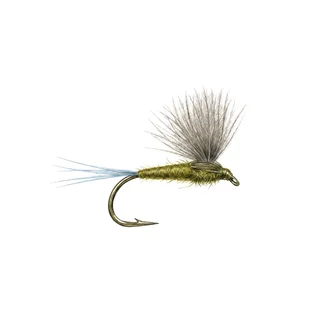
Fly illustrations · tap a fly to explore it
Fishing depth
0–0.1 m
Count down
No countdown
Dead drift · Static
The setup
- Line
- Floating
- Leader
- 3.7 m · copolymer
- Breaking strain
- 1.5–2.2 kg
Inner ring = beadhead · halo = buoyant · X-rating derived from breaking strain, approx.
How to fish it
Surface only. If fish flash under your dun without taking, they are on the nymph — regenerate rather than persisting.
Cast up and across so the fly arrives before the leader, and reach the rod upstream as the loop unrolls — the line lands already curved up-current and the fly drifts drag-free. One clean drift beats five hurried ones. Lift off well behind the fish.
A 12 ft tapered leader to a fine point; degrease the last 30 cm so the tippet sits under the film. Full build on the river dry leader page.
Where to put it
Pick one riser and stay on it — the pool tail fish are the easiest to reach from below and the first to spook. Cover the near seams before you wade a single step, and give the far-bank seam its own careful cast: it is the least-disturbed lie in the pool.
Why this plan
When trout are taking duns steadily, a single well-presented dry outfishes any team: there is nothing to tangle, nothing to sink the tippet, and every cast is a genuine chance. Drag is the reason rising fish refuse — the reach cast and a degreased fine point buy the drag-free feet that matter. Fishing upstream from behind the fish keeps you out of its window and lets you lift off without lining it.
What to change
- Follows, no takes: Refusals on the dun: drop to a size 18 F-Fly on a longer, finer tippet — smaller and flusher, not another pattern the same size.
- Fish stop showing: Rise over: regenerate — the fish will still eat the nymph for another hour after the duns stop.